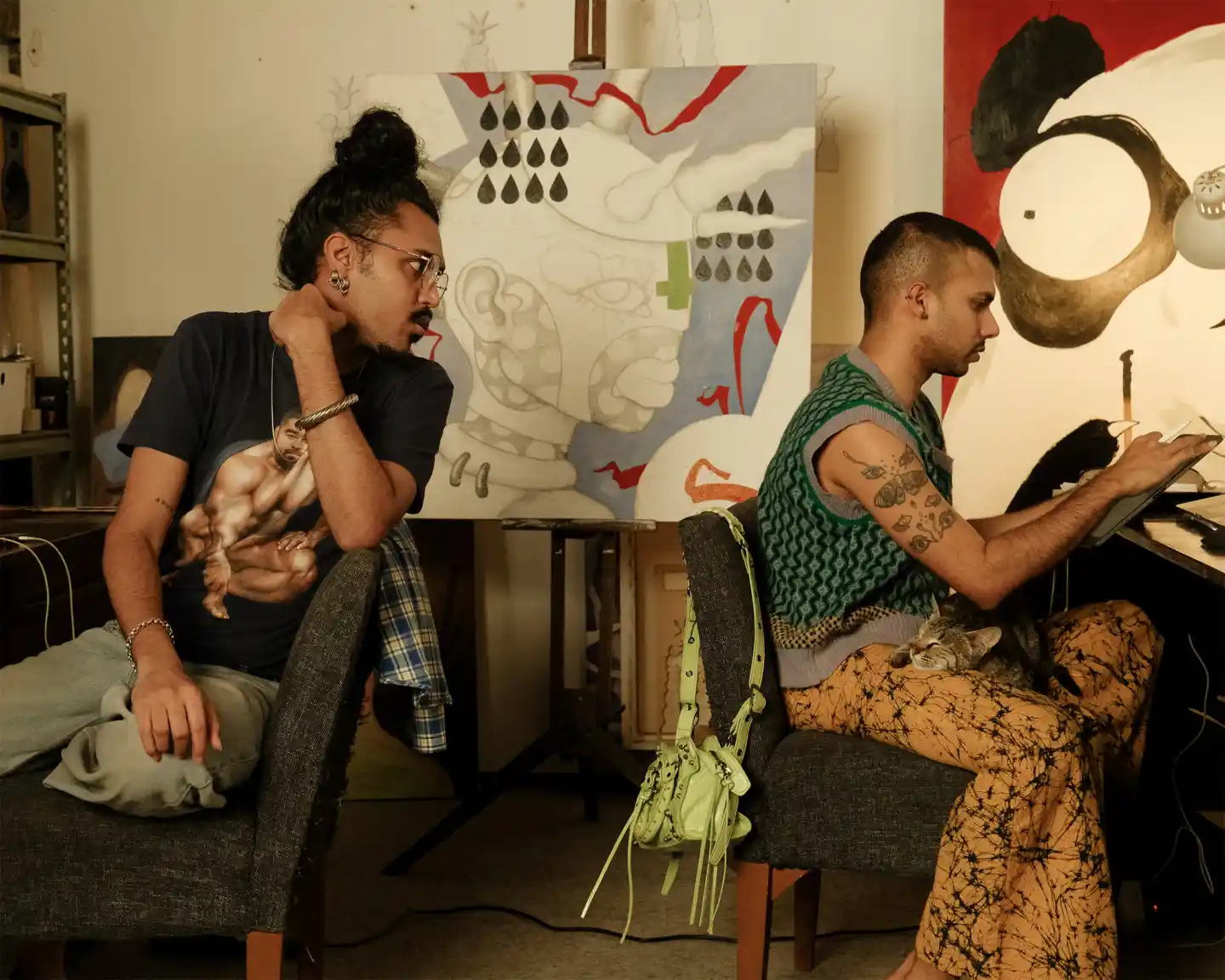
Consciously Co-working: Ishaan Bharat and Abhishek Desai
Juggling one’s work and a relationship in the present -day is challenging enough for many young couples. Verve finds out what happens when two partners share their professional space as well — and how they function when the lines between home and office blur
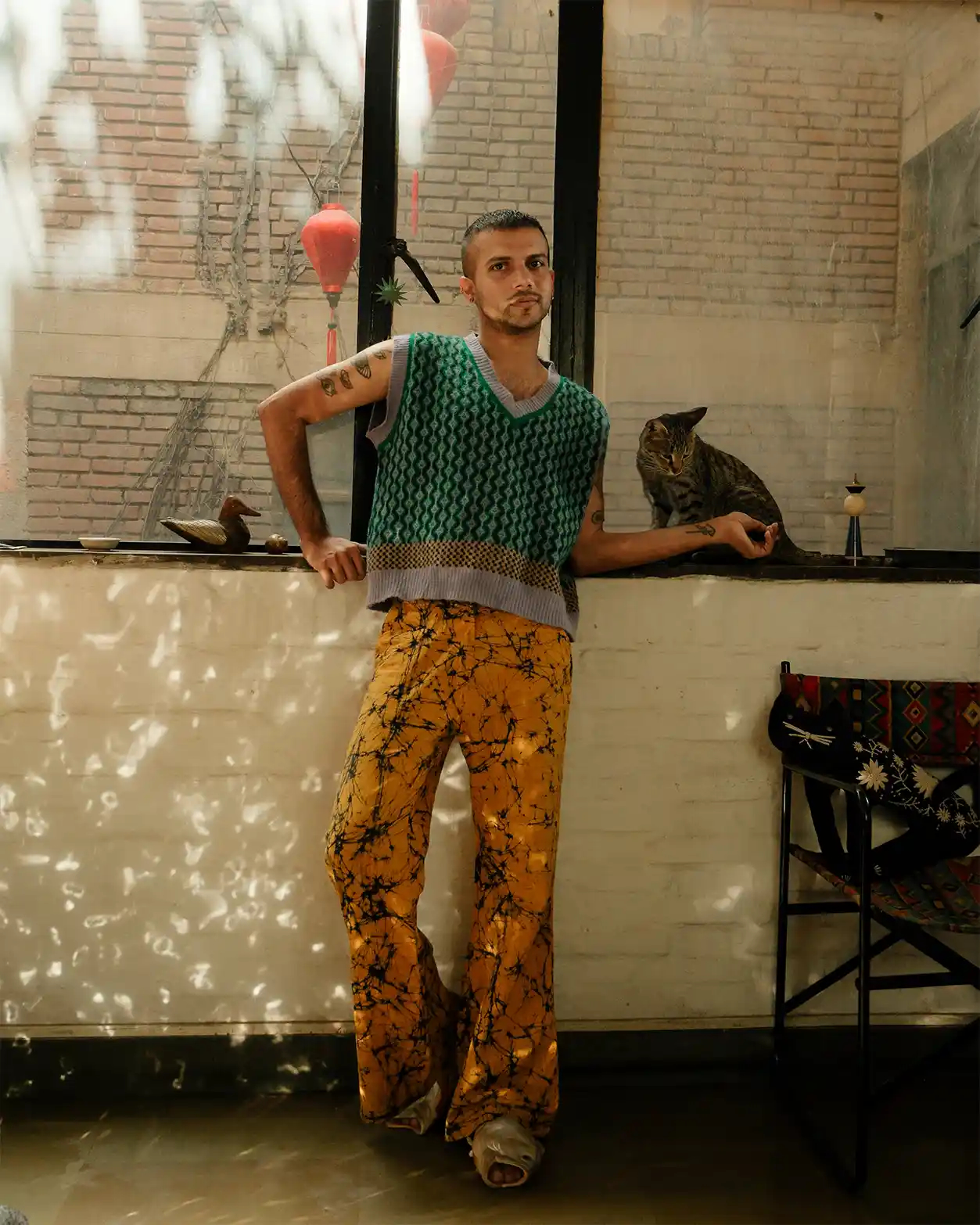
On Their Creative Practice
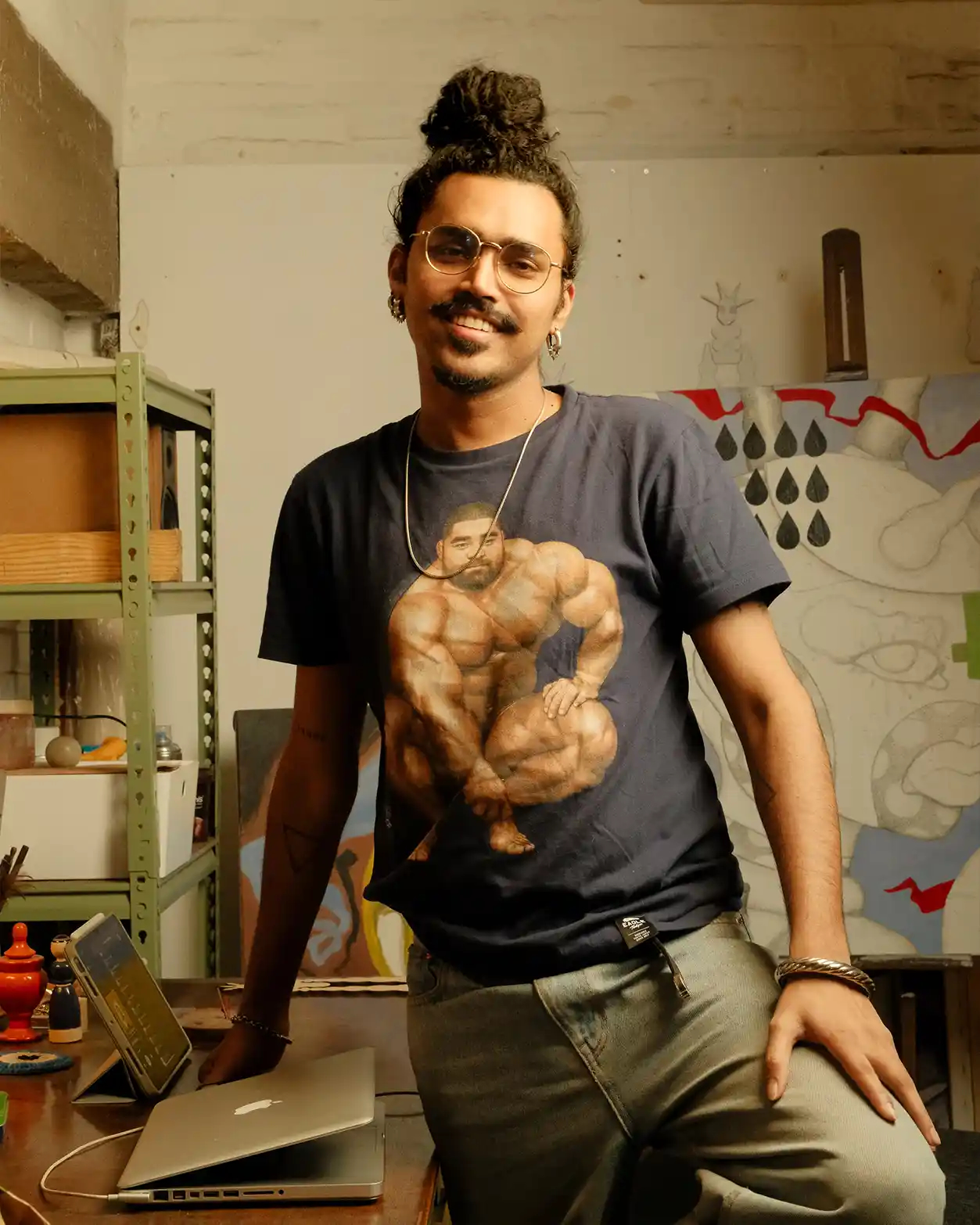
Ishaan Bharat (IB): I run Sector Form, an interior architecture, space design and set design studio through which I do art direction for brands. Now increasingly, I design spaces, both residential and retail. I also produce art objects for conceptual projects. So even if it’s a space like a concept store I’m brought on board to conceptualise and execute the project.
I also run Dragalactiq, a collective of queer creatives working in the performing arts. We curate drag shows for music festivals like Magnetic Fields, and events like Lakmé Fashion Week and India Art Fair. Essentially, we produce shows, but we like to describe it as world-building. We help artistes to develop their drag characters, collaborate with textile artists for installations and often curate creative teams for projects. At a personal level, I have a fine art, painting and art installation practice and I am also an aerialist.
Abhishek Desai (AD): I am a communications consultant in the non-profit space. My work involves creating campaigns, building programmes, organising communities and overseeing outreach. I am involved with pan-India issues, from climate to gender justice to education, with a key focus on youth. My background is in journalism, and I have worked as a reporter for about eight years before I transitioned into working with a non-profit seven years ago, which is what brought me to New Delhi from Mumbai, where I grew up. I am also involved in Dragalactiq with Ishaan.
On Finding Love
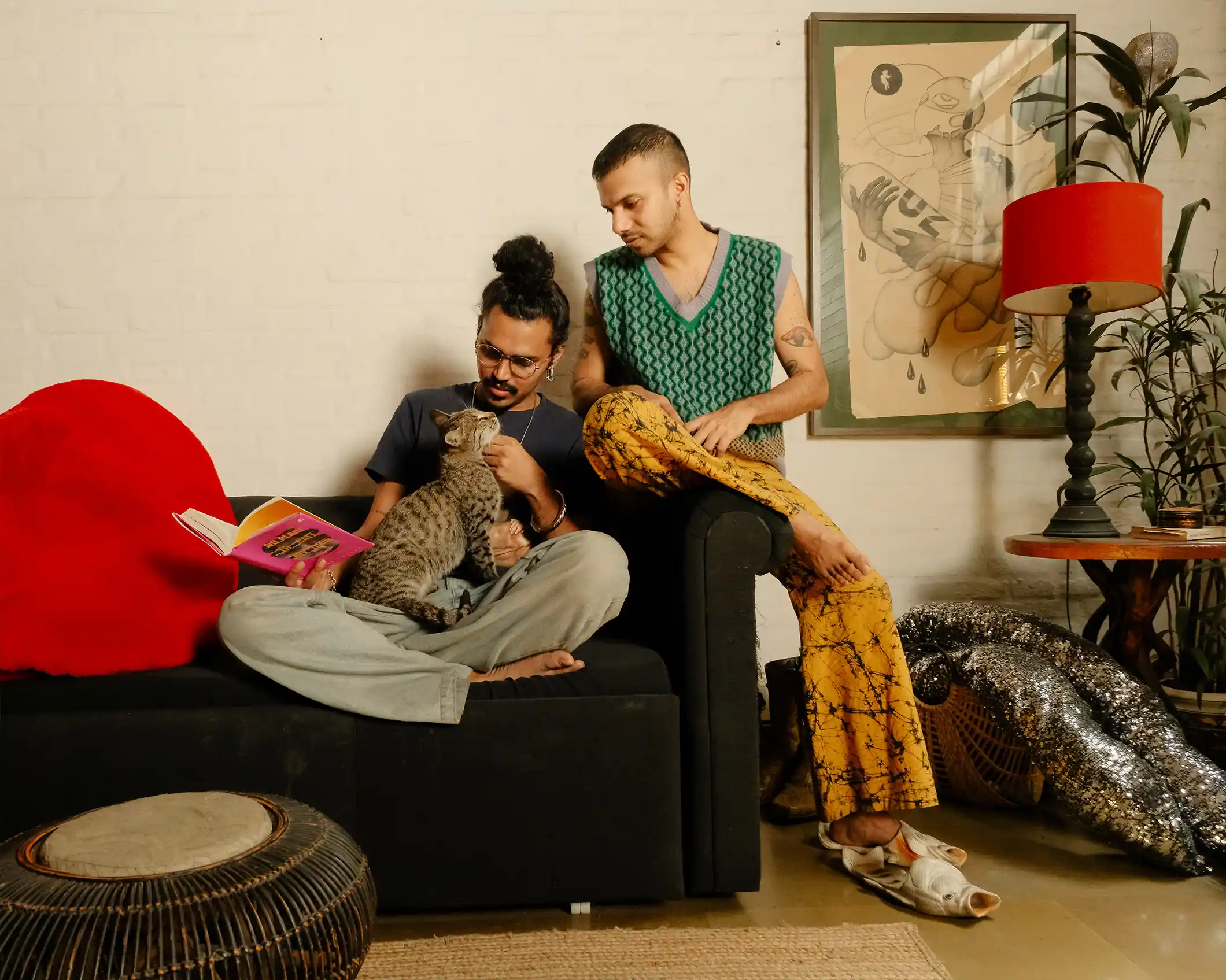
IB: We met through mutual friends. Abhishek’s name kept popping up and multiple friends would mention him, or recommend that I meet him. One even showed me a picture and I found myself drawn to him, so I made it a point to get an introduction. We were formally introduced outside the aerial gym I go to, which happened to be in his neighbourhood at that time. Abhishek was seeing someone then.
Our paths crossed again when he moved to Goa and I was travelling there for a few projects. Finally, one morning around 5 a.m., after a night of partying in New Delhi, we saw each other on Grindr and started talking on the app. Because we weren’t strangers, we made a plan to meet right then and I went over to his place and didn’t leave for the next 24 hours. I think we were immediately obsessed with each other.
We fell into a routine soon after that of me going to train at the gym and then going over to his place almost every other day. At night we would go to parties together. But it took us almost three months, after we told each other that we loved each other, to officially label our relationship. And I remember feeling like it was the first time that I was dating someone I also had so much fun partying with. A lot of my exes were amazing people, but they didn’t share my interests. This was also the first time that I was with someone who was exactly the same age as I was. It was just nice to be with someone who I related to completely, who had the same emotional and sexual maturity as me, and wanted the same things from a romantic partner. I think communicating openly helped us both to actively choose to be in a relationship.
On Being In A Relationship With A Creative Person
IB: Abhi recently quit his job, and I’m currently straddling a lot of projects, which I thought could create a flux in our relationship, but we have managed to find a good balance. We got together at a stage when we were both working on ourselves and that has had strong positive effects on our relationship. I started therapy. He was on a journey of his own. But we supported each other through it.
Our four years together have been really interesting, because we’ve helped each other understand ourselves with positive critique and honest feedback, not just in terms of where we need to improve or grow as people but also in our work, and especially our identities as queer people. I used to identify as gay, but now I’m not sure if I associate with being gay; my relationship with gender is evolving. I think we bring a nice combination of interests into each other’s lives where Abhi works in the human rights space and is very aware of what’s happening politically, and he’s a great dancer, whereas I have an artistic approach and look at things from the lens of aesthetics, beauty and design. There’s a nice to and fro, where he makes my work more sensitive and I push him to explore his love of performance, vogueing and character-building. Doing drag together has also brought us a new group of queer friends whom we’re both close to, including a lot of trans and non-binary folks.
Our relationship with each other’s families is interesting. I get along well with his mom. He’s also pretty close to my parents, my brother and his wife. We all went to Dehradun together recently.
On Their Decision To Share A Studio Space Together
IB: When we started seeing each other, I was living with my family in Noida.
AD: But Ishaan was at my place in GK-2 all the time.
IB: I was practically living with him, and I think for those two years, my parents’ place became a transit home where I would go to change my clothes or pick up things. That was the first time that I had spent so much time with a partner. After a while, my lifestyle got too nomadic for me, like I was neither fully here nor there. So in the beginning we were looking to live at his place together, and I was looking for a separate studio space.
On Finding And Setting Up The Space
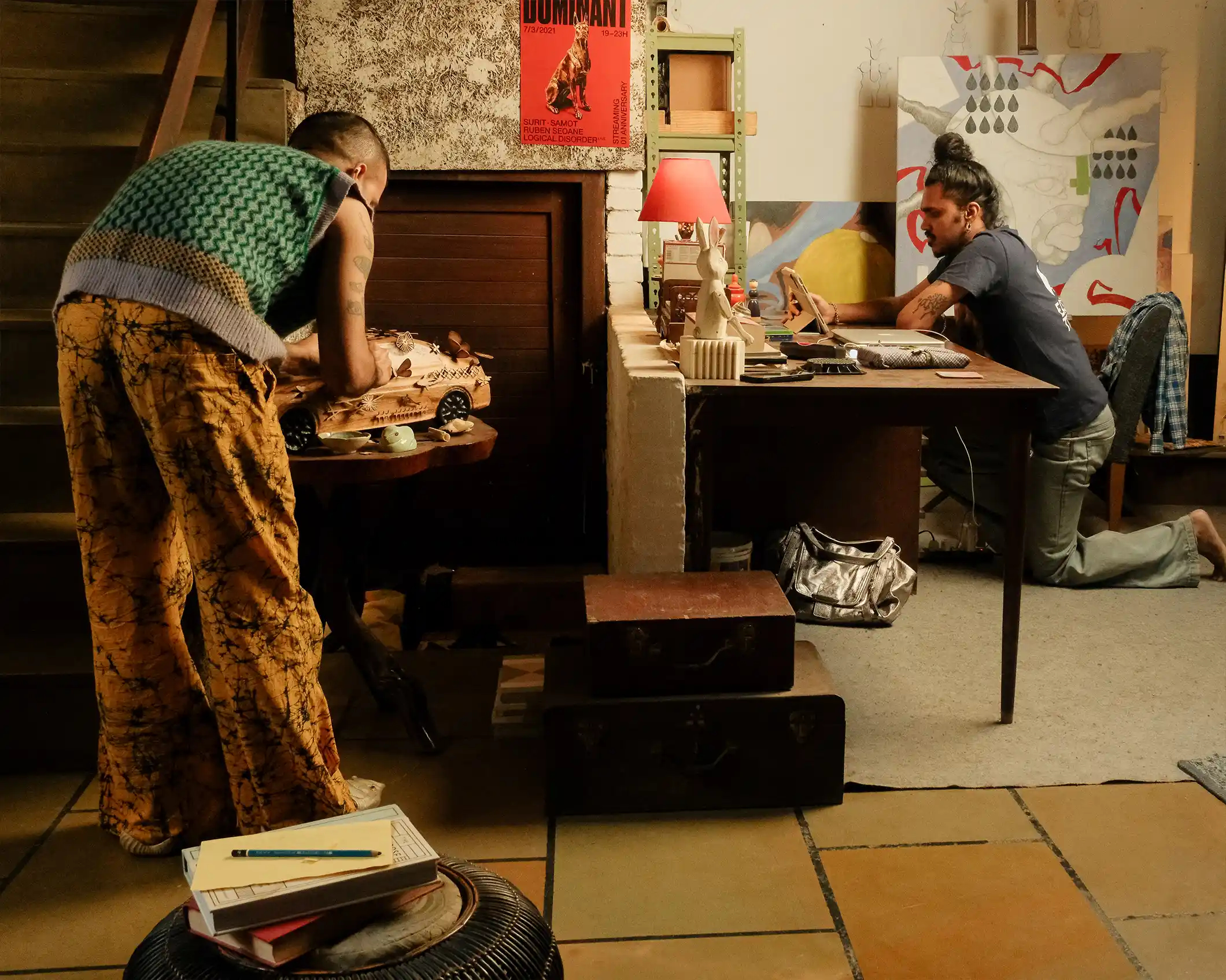
IB: When I saw this duplex in Saket, my plan changed. It had two bedrooms and bathrooms, and split levels and I thought it was perfect. We decided to keep two spaces; Abhi is mostly here, but we have the option of keeping things separate. For example, I bought him a large TV for his birthday but it didn’t feel like it fit here so we decided to keep it in his apartment, which is where we do movie nights now, and this duplex is where we work. I do my studio work downstairs and we also have our Dragalactiq meetings and make costumes with our tailor here. The study-cum-library upstairs is where Abhi takes his work meetings and calls. So most days we are working together but on different levels without interruption.
Landlords can be tricky to manage when you are queer and we had looked at spaces where we felt judged by the landlord. But my current landlord is queer-friendly and our friends feel comfortable with him too. He used to be a professor in Norway. The other day he complimented me on my chrome nails.
Once, a few friends stayed over, who are all drag artists and trans girls and he saw me seeing them off the next morning but he didn’t pass any judgement or make them feel unsafe. This space has allowed us to be open about our relationship.
On The Decor
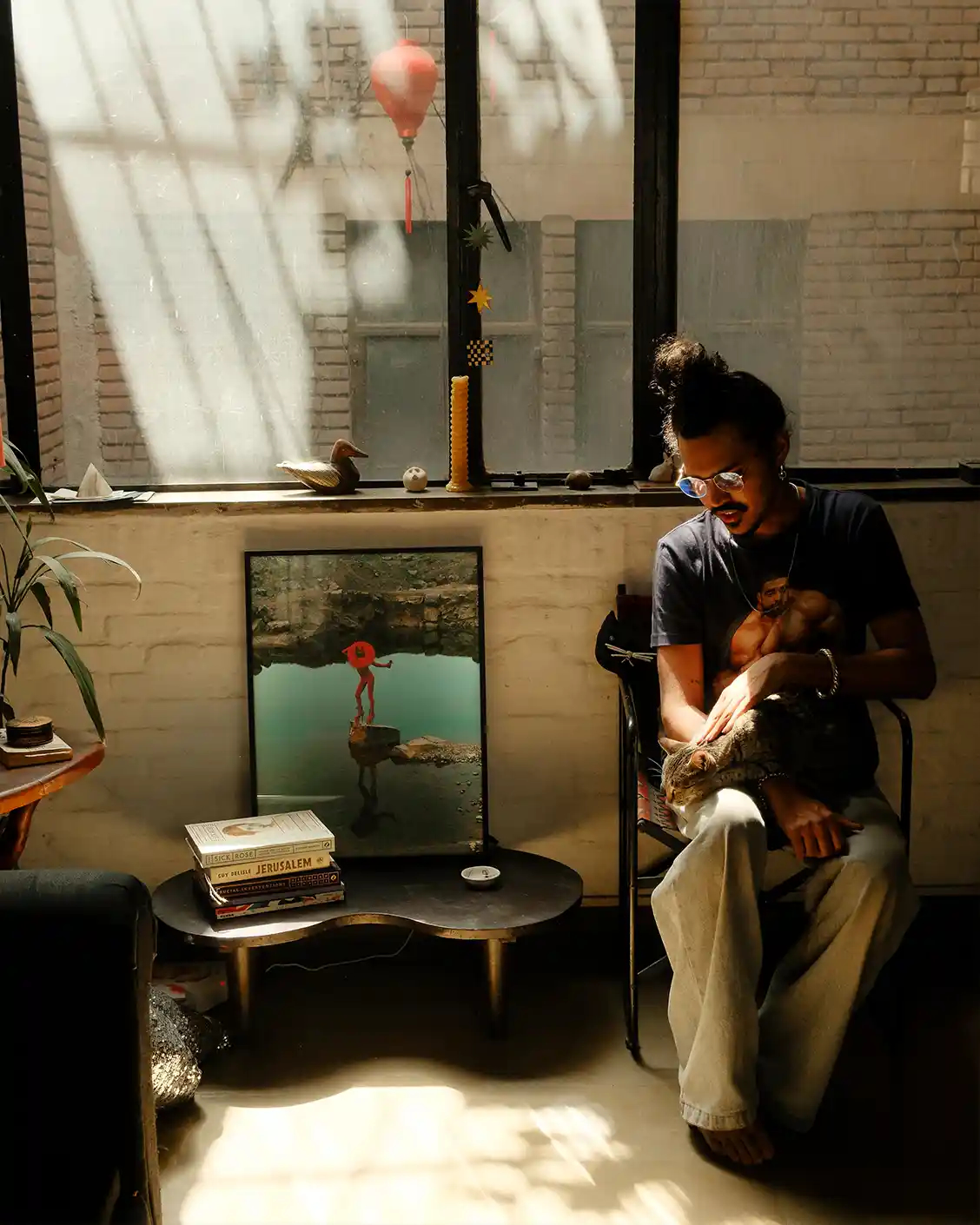
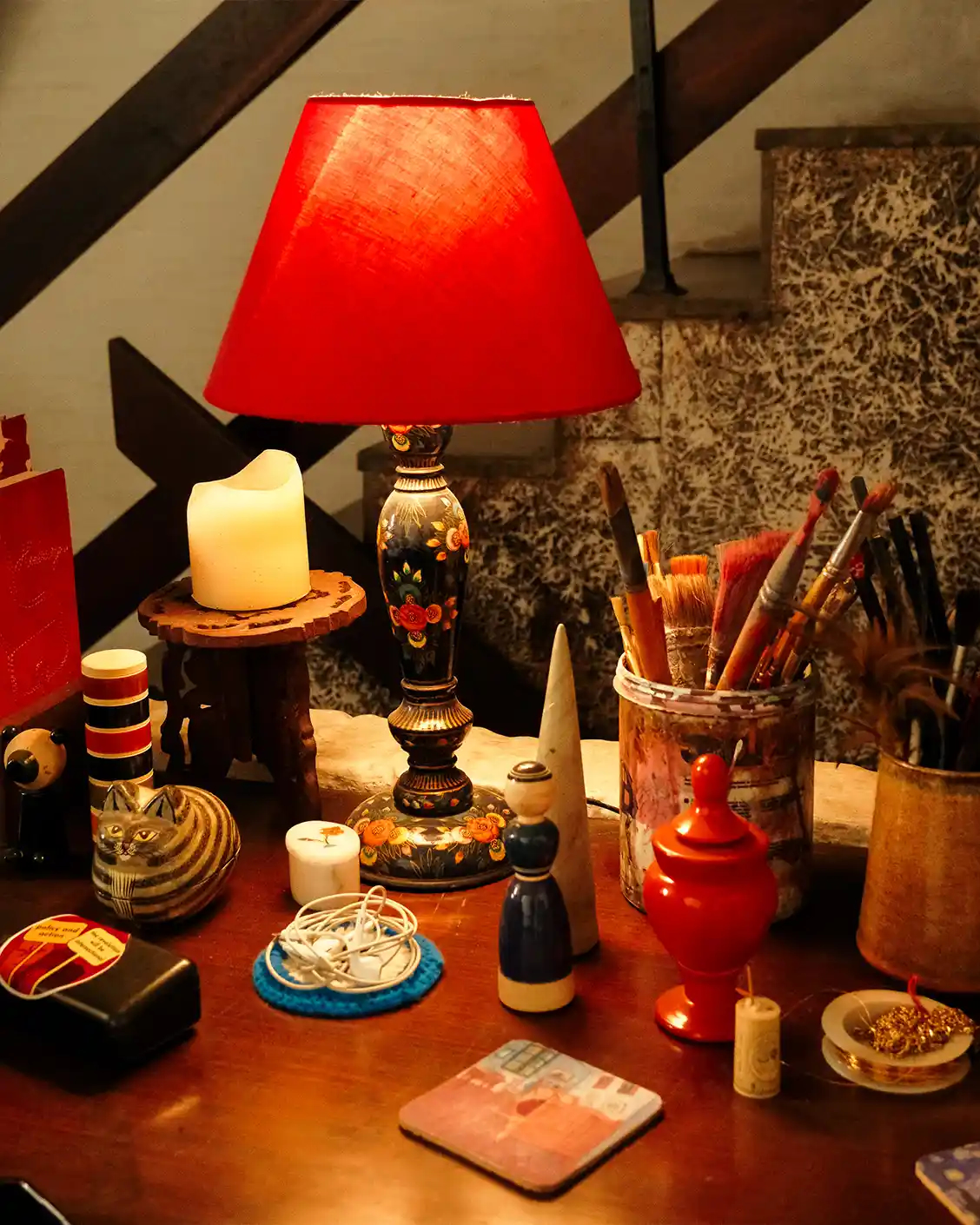
AD: Because I work in the development sector, my work is mostly online and hasn’t really dictated the design of the space. Even before we started decorating, we thought about the function of each room in the space based on where we collaborate, which is drag and performance, and where our work doesn’t intersect, which is our day jobs. Starting from there, we have decorated the common spaces together. I love thrifting for knick-knacks, and I collect vintage bags. I moved most of my books here as well. I read both fiction and non-fiction, and I also like gifting books. So a lot of the art and design books are gifts from me to Ishaan.
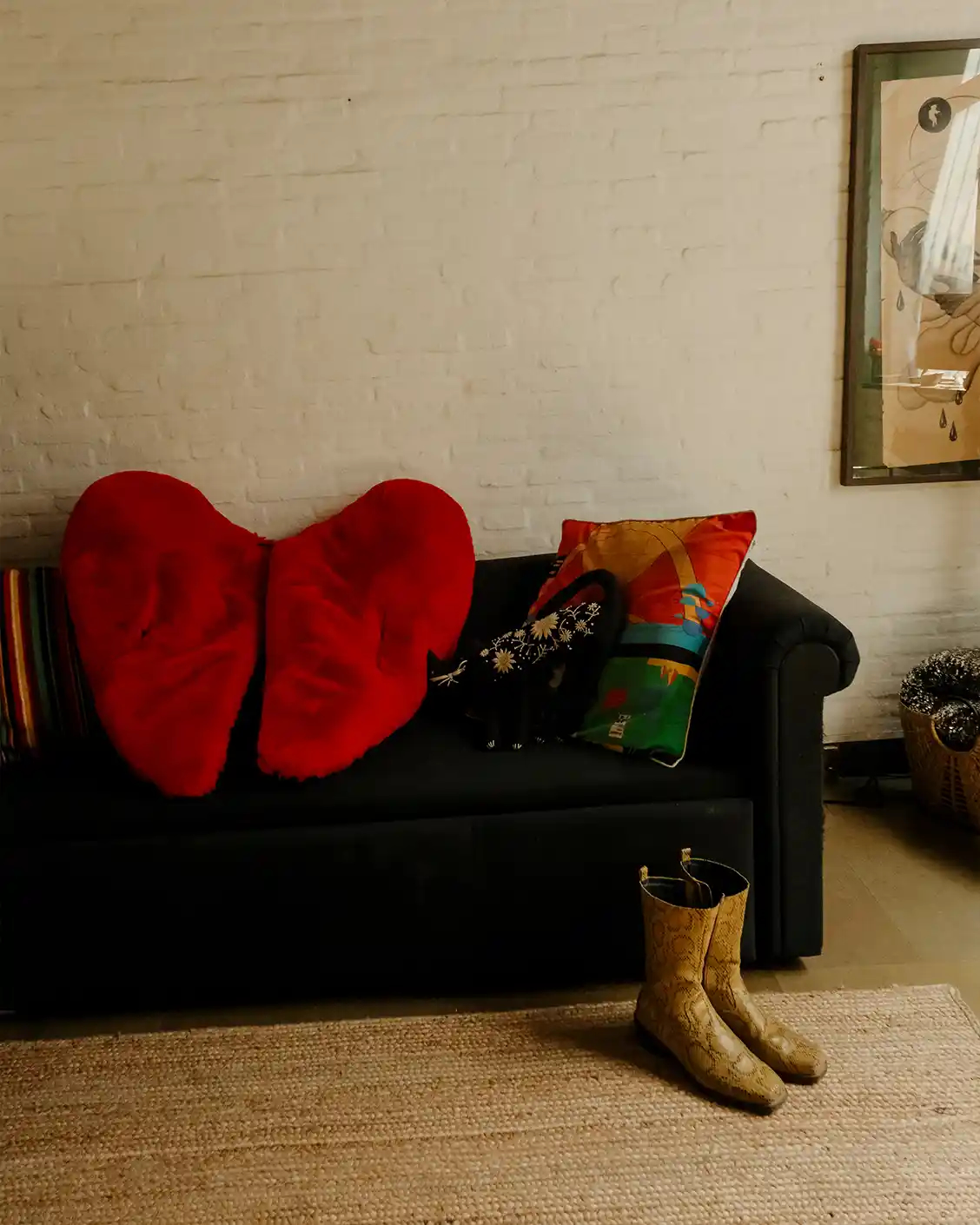
IB: I think we both have main character energy and a strong sense of style. What’s nice is that the rooms reflect that mix. The sewing machine has become an interior feature in itself. Often, our friends, who are fashion or textile designers, work from here with our tailor. Last year, we got a giant heart outfit made, and now it sits like a cushion in the house. A mix of tools and leftovers from installations or drag shows lie around at any point of time. We love shopping at Dastkar for rugs, carpets and unique furniture.
I would say the space has evolved into a hybrid between a creative studio and a living room. I had just cleaned and organised the space when my dad came over one day. He asked me why the furniture is always haphazardly placed — we have a formal living room setting around the coffee table, there’s a work table along with a bench press gym and the tall and uncomfortable silver seat comes from an installation. It looks unconventional because things are scattered, and depending on whether we are working, having a meeting or having a get-together, we keep rearranging the furniture.
AD: The private areas are primarily Ishaan’s, but there are glimpses of both of us around the house. Actually, it’s not just the two of us who live here; we are forgetting the cats that are very much a part of our family. We share this space with Suki, and her black kitten Koyla — and Ishaan is primarily responsible for taking care of them.
On Boundaries
AD: Once we set up this space, I realised that it’s the initial set-up that I am super keen on, but after that, I’m just someone who views spaces as a functional necessity — somewhere to sleep, rest and work from. Ishaan is someone who will keep rearranging things but I am not invested in the evolving aesthetics of the space. I might do that once a year but otherwise I just use it as it is; I rarely look into the upkeep. Because the duplex is also his primary living space, it is a give-and-take where he involves me and asks me for my opinion on things but eventually I step back and let him take the final call.
I generally take charge of things that need to be done quickly like what to cook or if something needs to be fixed, and I help out as much as I can. The one place I take full ownership over is the music.
On Financials
IB: We are still paying rent for two different spaces, but we have a common pool. Abhi helped me pay rent one month when I didn’t have enough money for it. We are constantly filling a need for each other or borrowing from each other. And we keep a basic tab of what we each owe, but very often we don’t think about it because it’ll balance out eventually.
On Routine
IB: Abhi loves to sleep in but I am a morning person. I wake up early around 7:30 a.m. and spend some time on the terrace with the cats, water the plants and get some morning sun. Then I come down and reorganise the space. Spaces have a strong influence on how my day goes, as is evident with my line of work. Even when I first met Abhi, and I was spending most of my time at his place, I realised that spaces are transitory for him; I was the one who would move things around and replace photos in his picture frames. On the other hand, he’s a lot less messy.
AD: I think the reason Ishaan needs to wake up earlier is because it takes him time to start functioning.
IB: Abhi will wake up at 10:45 a.m. if he has a meeting at 11 o’clock. I’m still amazed that he can get out of bed, tie his hair, wash his face, make a cup of coffee, and sit down to work in 10 minutes. Because I am someone who will take at least two to three hours to prepare myself for the day. I might reach my meeting one hour late, but I cannot rush and get out. Even the people who work with me know this.
AD: I think a good example of that is apparent when we travel. I don’t really care much about where we stay, besides wanting to be comfortable. But the aesthetics of the hotel or Airbnb matters a lot to Ishaan because he wants to live in that space and treats it as an experience in itself. I only see it as a place to go to sleep for seven or eight hours.
IB: It is true. I like to take my time to book and spend money on the ideal space because when I’m on holiday, I will still follow my morning routine, do my yoga…. We used to fight on holidays, but now Abhi will get up in the morning and go to his museum, and I will relax and join him for lunch.
AD: I don’t get attached to spaces. In fact, as a young millennial, for whom owning property seems like an impossible dream in the current economy, it is daunting to commit to a space and that’s probably why I haven’t officially moved in here.
On Memorable Moments
IB: A recent yet recurring happening is coming back after a late night of partying. A lot of our friends come over for the after-party because the space is familiar to them and I don’t have neighbours that complain.
What’s been nice is that there have been a lot of Sundays where Abhi is just playing music all day and it becomes a calming environment or background to nurse our hangovers, reset and spend the day working on creative things. Like, right now I’m working on an installation for which I’m making a smaller wooden prototype. It involves meticulously sticking together a lot of smaller, laser-cut parts onto the bigger model and I can’t work on it in the middle of the week with so many interruptions. I also have a junior designer who works with me, who comes in on weekdays. So those quiet weekends are really special, where we’re both sitting together, creating and talking. It is very peaceful.
We’re not like those couples who are stuck to each other. We like to do our own thing. And I feel like even when we’re in the studio here in Saket, we work around each other. And when we know an activity can lead to a fight, like cooking for example, one of us takes on the role of the assistant or sous chef.
On Future Plans And Dreams
IB: I have been thinking about whether I want to make this space more of a studio, or more homely. It became a little too formal after my junior designer started working from here as well, which I didn’t like. So I am letting go of that way of working and embracing fluidity again. The people that I’ve hired mostly work remotely and they only come in when required. What has helped is that a lot of the people that I work with are close friends. My best friend’s husband is the architect I work with the most. I’ve met a lot of the other creatives who I’m working with currently through Abhi.
AD: Sharing a space always comes with its challenges and clashes do happen. I think for me, if we are to share a space completely in terms of living and working together, it might have to be a different space because somewhere at the back of our heads, it will feel like it’s one person’s space that the other one is moving into.
IB: I agree. I think over time I want our home studio to remain an artistic space for Abhi and me. And home for me is wherever we are together whether it’s this space or his space or a new one.
We are holding off on a big decision together as of now. We were in Vietnam recently because Abhi quit his last job and he’s applying for opportunities in Southeast Asia, but I am not going to leave New Delhi. I am settled here. But when we were in Vietnam and living in Hanoi, we both did mention to each other that this feels like a city or a space where we could see ourselves living together. So we are trying to navigate these life decisions and again trying to stay fluid, whether it’s the spaces we share, our gender or even our queer identity.
Reflections On Commitment
IB: There are so many different ways in which you can decide things together as a couple. What works for you is best. What is special with us, and with a lot of people that I work with very closely, is that we are forming our own rules around commitment. Our generation has that privilege. It was different for our parents when people used to have arranged marriages, and then they grew to love each other. But we have the chance to date people of our own choice, and redefine these things.
AD: Being a non-binary person has taught me to view all of life through that lens, not just gender. It has become a philosophy of life for me and informs my decisions across situations. So when it comes to sharing a space, I’m also getting rid of the binary of ‘We either live together or we do not’. We could live together but also have spaces of our own. We live and work together as a couple but we also remain individuals. And I do want to emphasise that we have the privilege of being able to afford separate spaces which cannot be discounted. But we’re both wary of getting pressured by what qualifies as living together and sharing a space as a couple. People ask us what the next step is but we no longer view a decision as a next step but rather another step.
IB: Most people still think wanting to have a home together, or getting married, is a natural evolution or progression in a relationship. But for me, the fact that Abhi is important to my family too is a true evolution. In the beginning, I would fight with my mother because she would not give my relationship the same importance as my younger brother’s marriage; he’s straight. In my mother’s eyes, my sister-in-law Purvika immediately became a part of the family because that is legitimate. She thought I had commitment phobia for the longest time and didn’t take my relationships seriously. While that has changed with Abhi, I’ve also very consciously made sure I don’t fall for socially enforced tropes or get enamoured by them. We have set healthy boundaries and established what evolution is, on our own terms, not in terms of what is socially determined. It was a huge development for me to sit down with my family and assert to them that Abhi is not just my partner, but also my family now.
Together, we have set up this space as our own queer bubble. It feels like when we are here, we can be our purest, most unfiltered selves without thinking about what we’re wearing, how we’re being perceived. Inside, we enjoy all the privileges that a straight person enjoys in public. We don’t need to subdue our queerness. If I’m going for a site visit, and dealing with contractors, engineers and architects, I can’t be dressed in femme clothing even if that is what feels authentic; at that moment, I want to focus on work. I don’t want them to be paying attention to my identity or my clothing. Even with my own family sometimes I have to subdue and camouflage my queerness and not wear certain things.
So what I’m trying to say is that the kind of world we have built in this space together, is more important to us than the space itself. When I’m with Abhi, I feel free.
At the links below, read how these creative couples are sharing their spaces.
Shreya Josh and Rohan Kale
Mallika Tandon and Nishant Mittal
Back to Introduction