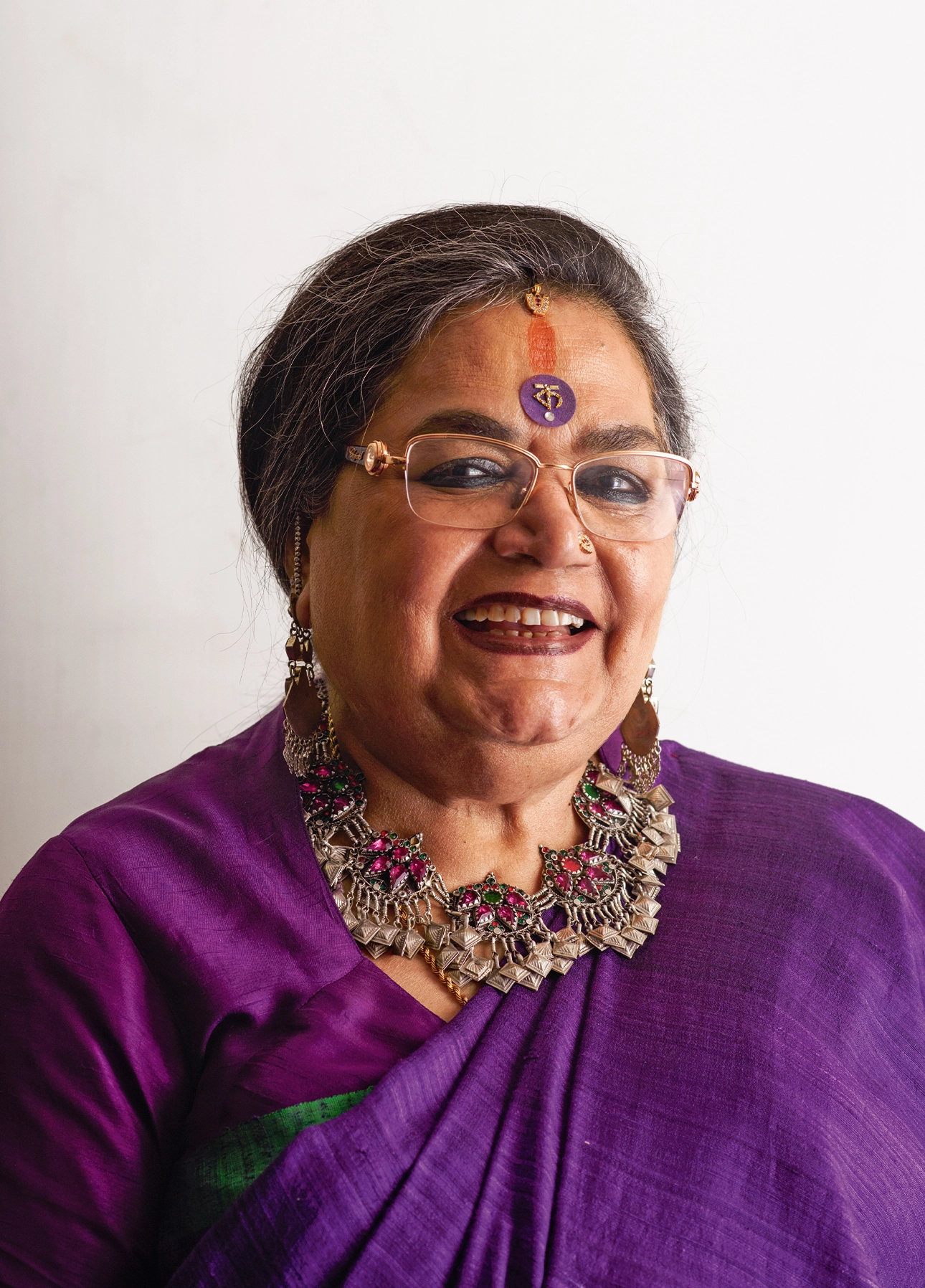
Usha Uthup starts with a feisty disclaimer — “Hope you are recording it because I talk fast” — which really sets the tone for the interview. As soon as I hear that voice over the phone, I know it’s on. Starting her singing career in a little-known nightclub in Madras in 1969, Usha Uthup went on to perform at the best spots in the country — including Trincas in Calcutta (now Kolkata), Talk Of The Town (now Pizza By The Bay) in Bombay (now Mumbai), and the Oberoi hotels in Delhi, where she got noticed by Shashi Kapoor. Recording more than a hundred albums in 17 Indian and eight foreign languages, she has sung in several thousand concerts around the globe, but never without her sari and bindi. “It’s not how good or bad a singer you are but how original a singer you are and that’s what’s kept me going besides being 100-per-cent Indian in whatever I do on or off stage. My being is totally Indian.” The 75-year-old, who wears the love for her culture on her sleeves, emphasises, “I’m a Tamilian, my janmabhoomi is Mumbai, my karmabhoomi is Kolkata. All this filters through my dress and definitely my bindi.”
Back To The Beginning
“Oh, now when you look at it, it’s a package deal. ‘Usha Uthup’ means the sari, bangles, flowers in the hair, and the bindi on the forehead. A lot of people ask me, ‘Is this a strategy, a marketing thing, or positioning?’ All I can say is that because I come from a very middle-class family — and I keep saying that because it’s important — I saw my mother, aunt and sisters wearing it. So, I also did it. We all used to wear something called a chaand, C-H-A-A-N-D. I don’t know how you would write it in English because it will sound like the moon, but it isn’t. The chaand, in Tamil, is a liquid material that came in a little bottle. A glass stick with a small bulb-shaped tip accompanied it. So you dipped that in the liquid and then put it on your forehead. And then when the stick broke we would use a matchstick and apply the dot of colour with that.”
On Becoming Synonymous With The Bindi
“It started off as a small dot. Later, I started making designs with it. I used to use kumkum, the dry powder. And then came the time when I started singing and I really changed the whole thing up. Bindis in India also started changing around that time and by that I mean the material. We now had something called Shingar, which came in the liquid and then stick-on format and gave us so many colours. But before that, I used to use Camlin acrylic paint, and I would use the paintbrush. I would do it with different colours to match my saris. The size and shade kept changing because I started wearing different kinds of saris and colours but the bindi soon became a trademark. Usha Uthup’s face without a bindi is not acceptable. If I’m out in public and by mistake I don’t have the bindi on, if I had rushed to catch a morning flight to Kolkata and had thought, ‘I could do in the car’ but hadn’t, or had decided that I will wear it in the aeroplane and it hadn’t ended up happening, the airport staff in Kolkata will always ask me, ‘Kothaye? Tomar bindi ta kothaye?’ (Where? Where is your bindi?) [laughs]. Babies and even the men notice it [pauses]. Everybody looks for the bindi.”
On What The Bindi Means To Her
“Of course, I don’t look at it as just decoration or a fashion statement but something more. The fact of the matter is that people look at it as a fashion statement. I look at it as something I grew up with. It is a sign of marriage among Hindus; widows don’t wear a bindi. But now of course it doesn’t make a difference if you’re widowed or married; it’s decorative.
But at least for those five seconds when you stand in front of the mirror in the morning and touch the forehead with your finger that has the kumkum or vermillion on it — as I’m doing while talking to you just now — think about your inner self and the soul. Chat with your soul. Look into yourself. I often do a quick introspection of what has gone by the previous day.”
On Her Unique Bindi Style
“Nowadays, I order it, the big red, black or purple ones, from Mumbai, because I don’t get that size everywhere. Then I decorate it with the Bengali letter kaw. I use the trishul as well, to denote woman shakti. I got the ma in Marathi and the word isai, which means music in Tamil. For Delhi I got the letter da in Hindi. People don’t know this but I’ve also got the letters printed on my saris. Even foreigners and people from other regions, who don’t know what they mean, find it interesting and want to know more. I also have a bha for Bharat and I put it on when I’m travelling. Say, if I’m going to Gujarat or some place I don’t have a letter for. I wear it more prominently, happily and conscientiously when I’m abroad.
For an artistic person, a singer or a dancer, it works, it really works. The letters, for example, were all me, it was my idea and nobody else has ever done it before. I got a lovely letter in Malayalam also, kaa for Kerala.
It started with the video of the Kolkata song in 1996. Before I started doing the video, which had many big artistes in it, I got a sari printed in Bangla by Nanditadi (Nandita Raja) of the Kanishka boutique in Kolkata. For the visuals, I wanted the kaw to be on my forehead as well, just like it was on my sari. Actually, the whole thing started off with the thought that if we can wear a T-shirt that says ‘I Love New York’ or ‘I Love London’, why can’t we say ‘I Love Bombay’ or ‘I Love Delhi’ or ‘I Love Kolkata’ through our attire? This was long before T-shirts with such prints became trendy in India.
Now, people look forward to what bindi I’m going to wear. And it has become a part of my sartorial statement.”
Centre of Attraction: Introduction
Centre of Attraction: Dolly Thakore
Centre of Attraction: Aroona Bhat