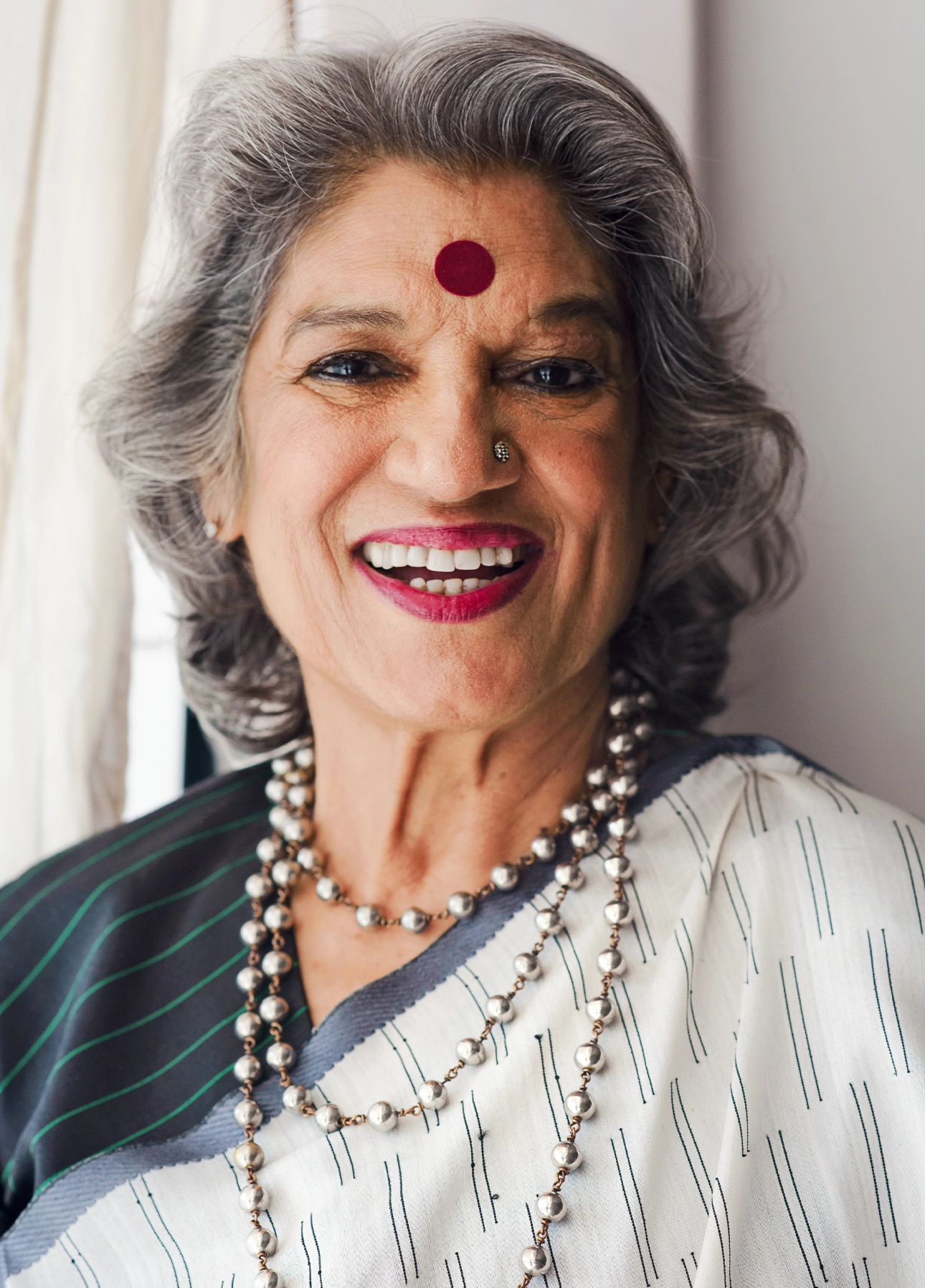
Her bindis are striking, assertive and, by her own admission, sought-after. A lot like her, in other words.
Dolly Thakore had generously let me in, opening up not only her home but also about her personal life by giving me access to her oldest black-and-white photo albums. Alyque Padamsee, danseuse and fellow bindi lover Protima Bedi (“My soul sister!”), film and theatre personality Vijaya Mehta, writer and TV personality Kamleshwar, Kaifi Azmi, journalist Nandini Chandra (“That’s Vikram Chandra’s mother and my best friend!”), Jawaharlal Nehru, Ameen Sayani, Farrukh Dhondy (“We grew up together and he’s still one of my closest friends”), Richard Attenborough (“See, I didn’t wear a bindi during the making of Gandhi….”) and Thakore herself stared back at me, frozen in time. We are sitting cross-legged on her carpeted bedroom floor, poring over the pictures, as she reminisces. One wall has been entirely usurped by books. Thakore has taken on the mantle of a DD newsreader, BBC journalist, auctioneer, publisher, actor, casting director and more in her decades-long career and her Pedder Road house, strewn with artefacts, art and books of a varied range, reflects her multifaceted persona.
We are in the living room now and she points to the walls splattered with photographs and paintings. “Look at the pictures, I’m wearing a bindi in all of them. I’ve been wearing a bindi for over 40 years now,” says the 76-year-old. I look around and spot a Husain (“That’s the Mother And Child painting he did for me when Alyque left me,” she remarks with her signature candour), a Pritish Nandy, an Anjolie Ela Menon, a curtain depicting Bedi. The house is brimming with stories, much like its owner.
Back To The Beginning
“I began wearing a red bindi when I started reading the news on DD in 1974. The make-up man used to do it for me. I haven’t stopped wearing it since. Unfortunately we didn’t have selfies back then! I was with the BBC in London for almost four years, and I never wore anything but a sari to office. I wore a little black bindi too. In college, I matched colourful ones with my clothes. And today, I have a bindi on irrespective of what I wear.”
On The Cultural Appropriation Controversy
“I have no hang-ups or reservations about anybody doing anything. I went to Germany and the people there wore my saris and bindis. They loved it and accepted it and it was wonderful. I don’t wear make-up at funerals because people say you shouldn’t, but I wear my bindi. And this whole thing that only a married woman can wear the red one, I don’t subscribe to any of it. It’s become a cosmetic thing today and has nothing to do with following a religion.”
On The Many Types Of Indian Bindis
“No more is wearing a bindi decoratively a taboo or frowned upon. But it has evolved into this. There was a time when unmarried Marathi women could only wear a black bindi. Not a red one. Each region has a different folklore attached to it. The Rajput woman always wore a bindi. Before the Rajput men would go to war, the wives would do a puja. The man would put a red vermillion tika on the wife’s forehead which was meant to shield her from harm. When he died, all the person who came to break the news would do is wipe off the mark.”
On Her Look
“In this building, I’m the only person who wears a bindi. That [she points to an abstract piece of art] is a painting of a face with a bindi, an American artist gifted it to me. That’s me. I am identified by my silver bangles and the bindi. I was never a follower of trends but I would wear a long bindi at one point. I met Alyque in 1970, and I didn’t have one back then. When Quasar, my son, was born (in 1978), I didn’t have a bindi. But now you’ll never find me without it. I can’t recognise myself without one anymore; it feels incomplete. People are so starved for something innovative that they take to fads, but it doesn’t last long. My bindi has endured.”
Centre of Attraction: Introduction
Centre of Attraction: Usha Uthup
Centre of Attraction: Aroona Bhat