Carved To Imperfection
New York-based ceramic artist Jane Yang-D’Haene exhibits an exclusive collection, The Place That Waited, at Mumbai’s Nilaya Anthology, where she continues to build on her emotions, and on being Korean in America
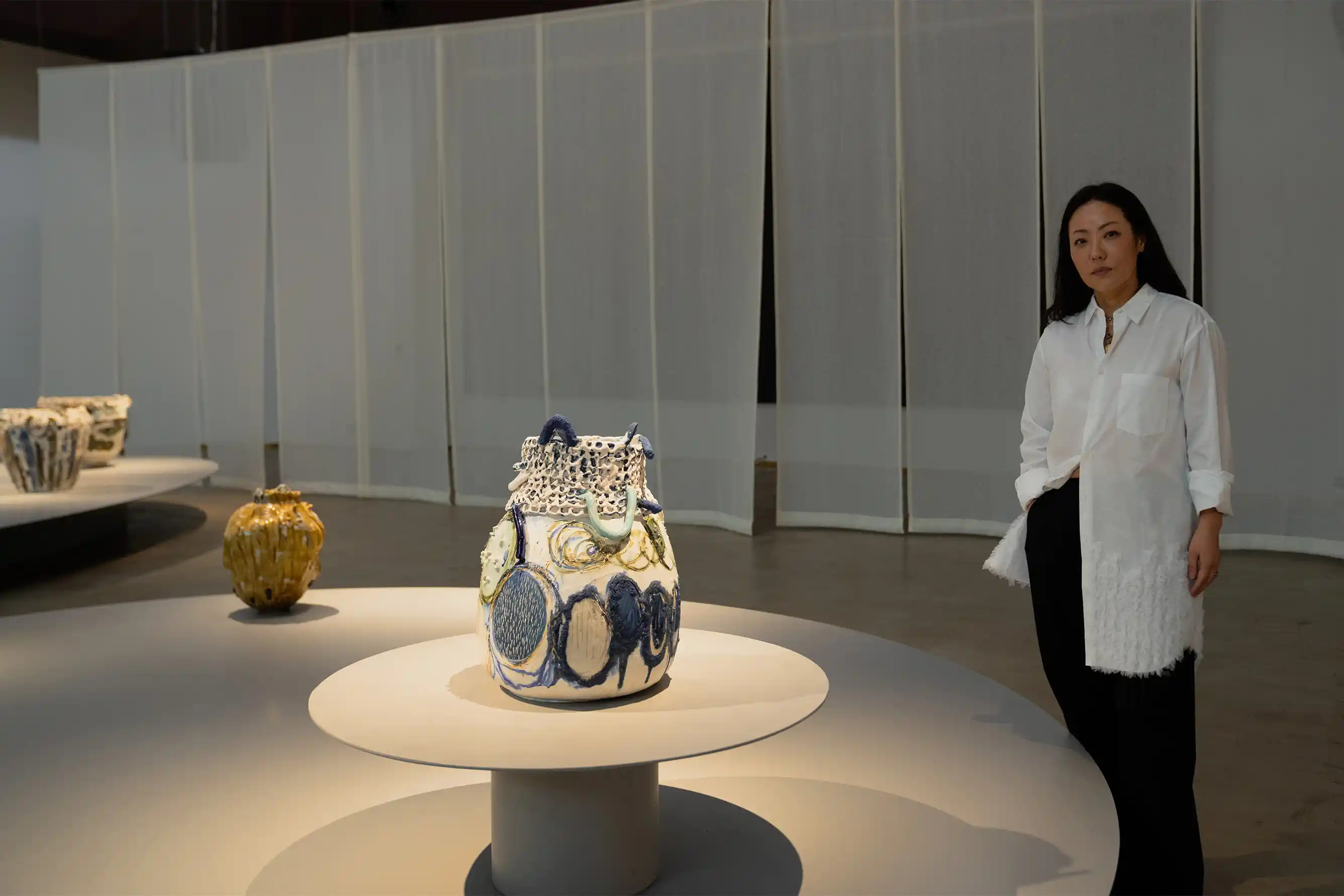
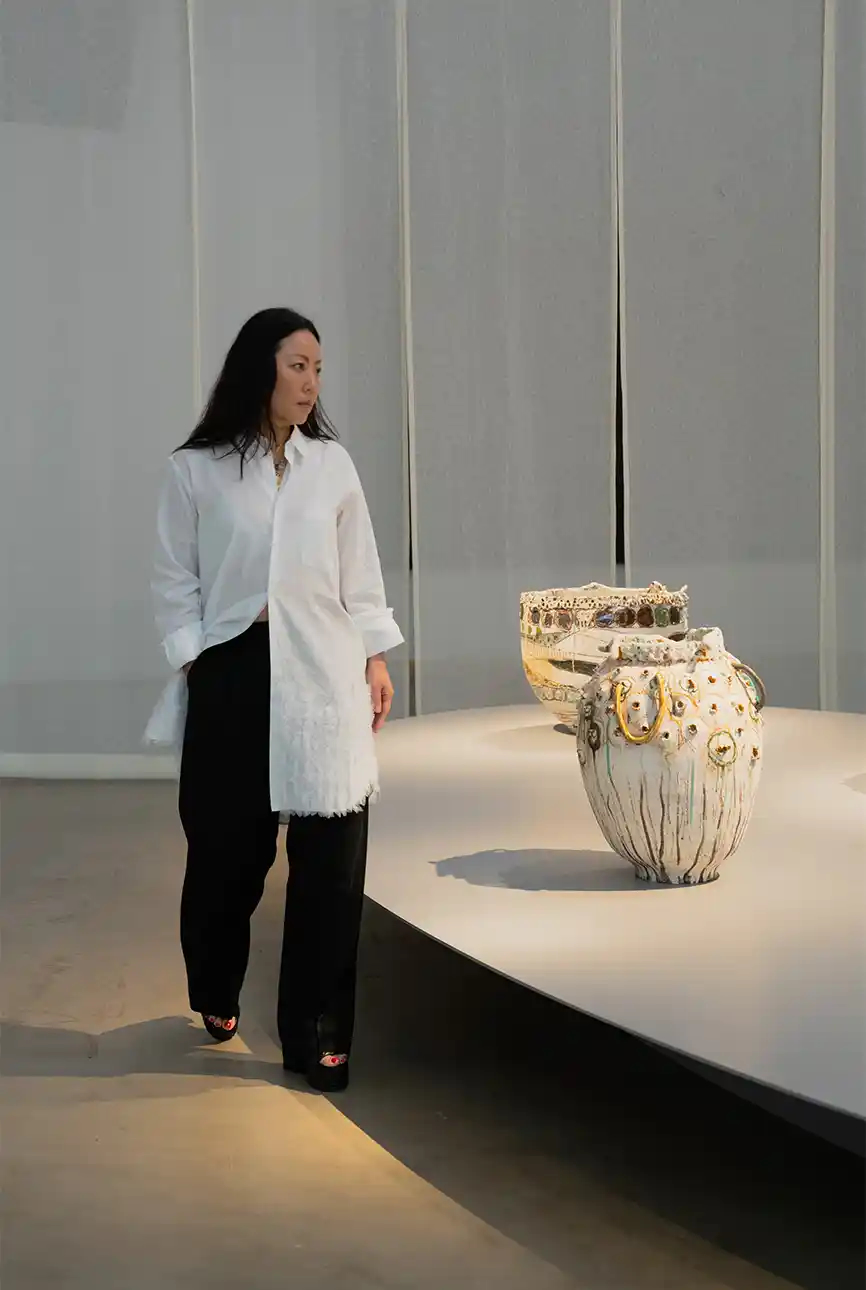
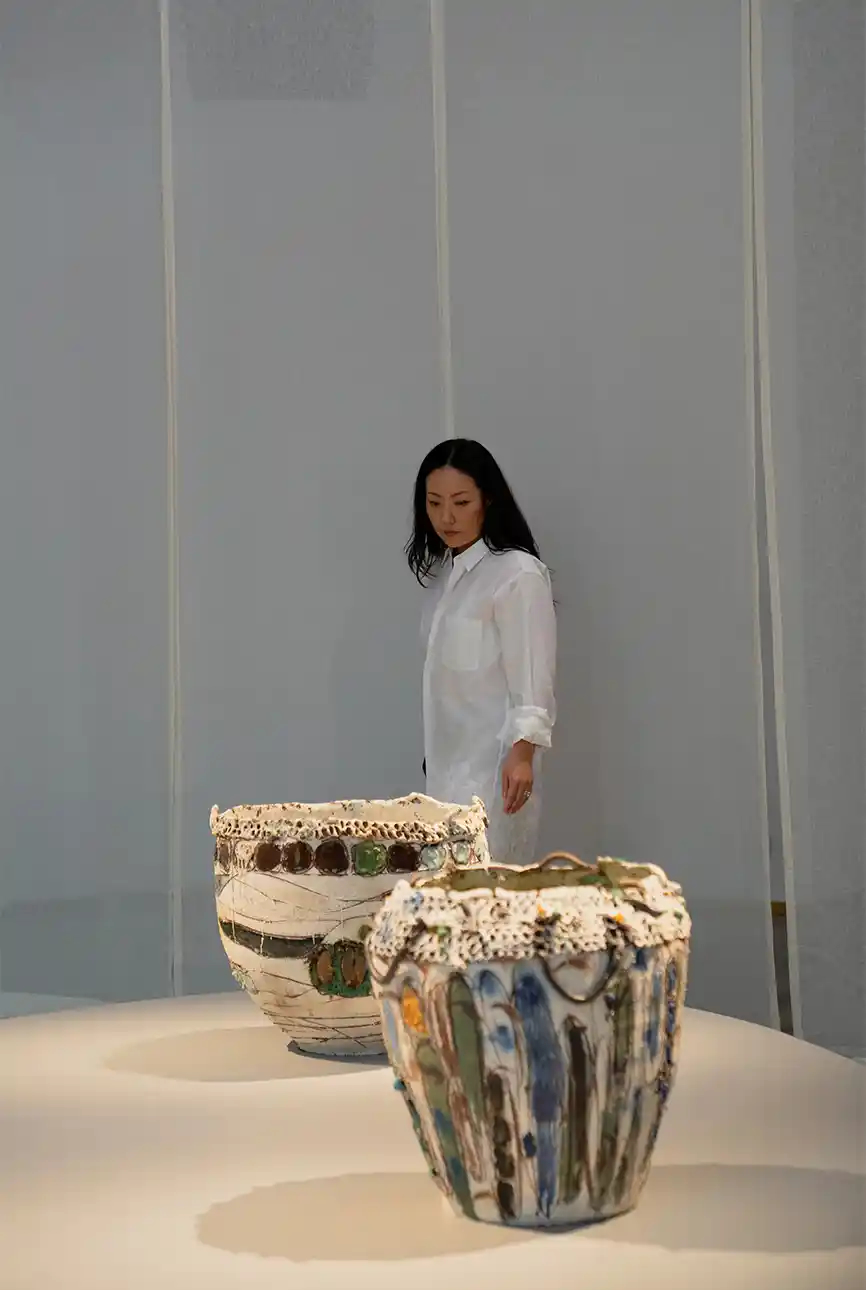
A potter comes to town. And in her wake arrive 16 handcrafted stoneware vessels, their pitted textured surfaces meticulously sliced and carved, intricately painted, abstract in their aesthetic, unconventional in their imperfectly formed beauty. Her Korean heritage gives Jane Yang-D’Haene the basis for her work, especially in the traditional form of the dal hang-ari or moon jar to which she brings innovative embellishment in the form of contemporary surface patterns while her early training in architecture lends them a sculptural quality.
Her life as a Korean-born American woman living in New York and childhood memories provide inspiration as she seeks to express these in physical form. As does her body replete with scars of illnesses and surgeries. Her candour is novel, her honesty invigorating and apparent in the pieces on display at her solo exhibition, The Place That Waited, at Mumbai’s Nilaya Anthology, as she continues to experiment with her sense of self and her relationship with clay through her oeuvre….
Verve speaks to the ceramic artist — a veteran of more than 50 exhibitions — about her creative processes and the integral part that memories play in her work.
Excerpts from the conversation…
In connection with you coming to India — with the mix of cultures and philosophies — how were you inspired to create an exclusive collection for Nilaya Anthology, given that your work is already tied to your culture? How did that mix play out?
When Nilaya Anthology approached me, I actually took a really long time to think about what it was that I wanted to introduce in India. To be very honest, I didn’t really know much about the history or the current status, so I wanted to take my time.
For me, it was exactly the same approach as with my work — my interpretation was to build it slower than other exhibitions I’ve worked on. It was more like a meditation process — building the history indirectly, layer by layer. While working, I thought a lot about my emotions, and about the histories of being Korean or being Asian in America. I just wanted to build those layers through a slow process, and that’s how I wanted to present my work.
In that process, did you have the chance to look at any specific ancient Indian ceramics or studios?
To be honest, I really did not want to, because I wanted to introduce my work as it has been throughout my process. Now that I’ve seen the energy of Mumbai, the space, and learned a little more about India, the next pieces I create will be completely different.
What are you experimenting with right now?
Currently, I’m actually shifting a little more toward sculptural work. I mean, it’s always been sculpture in a way, but now I’m moving toward larger pieces that aren’t necessarily vessels but more abstract forms. It’s shifting….
Does your background in architecture tie in there?
Yes, I think so. I always think a little more spatially than individually, per piece. So yes, the work is moving more toward installation.
How does clay as a material, as a medium, tie in with your internal sensibility — as a form of expression?
I’m a very controlled person. I’ve even suffered from OCD (obsessive compulsive disorder) — I like everything very perfect. What clay taught me is how to let go — and that I can’t control everything.
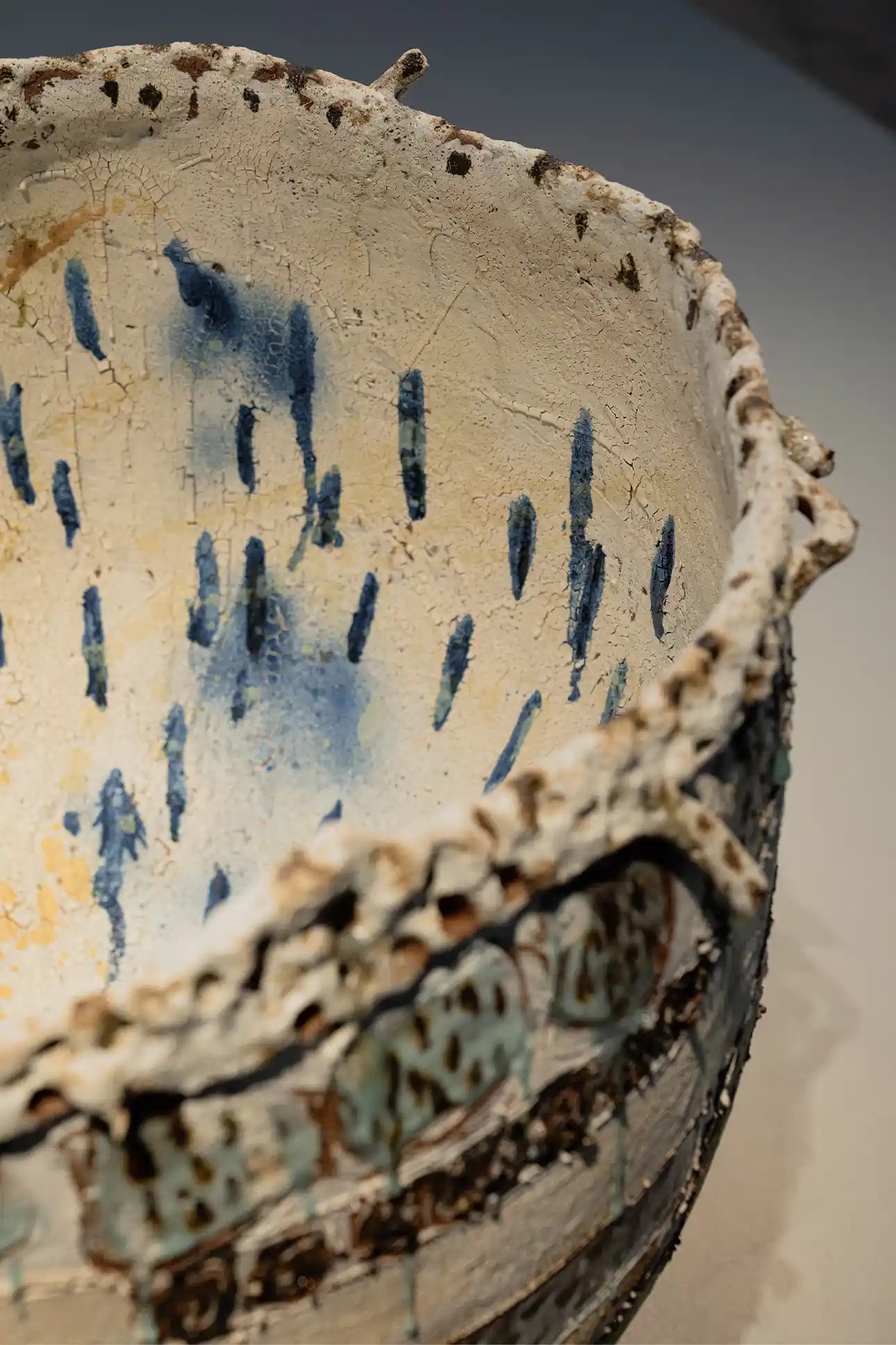
What’s interesting about clay is that when I push its limits, it tends to break. If I keep touching and working on it, it dries, it cracks, it breaks. So, at a certain point, I have to let it do its own thing.
At the beginning, that was really hard for me because I like controlling everything. I’m a very Type A person; everything has to come out exactly how I envisioned, perfectly. Of course, there’s no such thing as perfection, but for me there’s always a definition of it. As I worked more with clay, I realised — it’s okay not to be perfect. It’s okay to be broken, crooked. Clay lets me let go, and that’s what’s so beautiful about it.
Sometimes I work with porcelain mixed with stoneware. Porcelain is fascinating — it has memory. For example, I can make a perfect piece, bump it accidentally, fix it — and yet when I fire it, it still comes out with a slight dent. It remembers. And that makes me think: I need to accept myself the way I am. That’s what’s so interesting about clay.
Would you say those flaws have become important to you now?
Yes, absolutely. That’s become part of my work — accepting it. Like life — we go through difficulties, mistakes, traumas, dramas — and clay does the same thing. Just because I’ve had difficulties doesn’t mean I’m not a good or beautiful person. I relate that with this material. Even if it’s broken, I can put it back, turn it into another show, another piece. It’s still beautiful, even with all the broken pieces.
I think that’s very apt for the Indian context — our connection with clay is also deeply philosophical. Could you tell me about the name of the exhibition? What’s the story behind The Place That Waited?
I didn’t think of it as a physical place. I wanted the title because every time I make my pieces, I go back to the places where I’ve been — to memories of my childhood, or moments during making.
The way I create, it’s not just one or two firings. Every time I apply a texture or glaze, I fire it, bring it out, apply again, and fire again — multiple times. Each firing takes me to a different place, but I always return to certain cherished moments in that process. I wanted to capture that — it’s not about one place, but all the memories and places I want to return to.
Yesterday, I walked around South Mumbai and took a lot of pictures. Some of those colours and textures — I know for a fact when I go back — they’ll show up in my work.
Traditionally, moon jars are fired in wood kilns?
Yes, but I use electric kilns. Unfortunately, I don’t have a wood kiln —you need to build it outdoors, it’s large, and not allowed in Brooklyn [where her studio is located]. I have three electric kilns of different sizes.
Tell us about your actual process. From an external point of view, it looks abstract. Is it also abstract to you? What goes on in the studio that we don’t see?
I always start with drawings — not necessarily each piece, but for each exhibition, I sketch forms, write, plan. Then I start building.
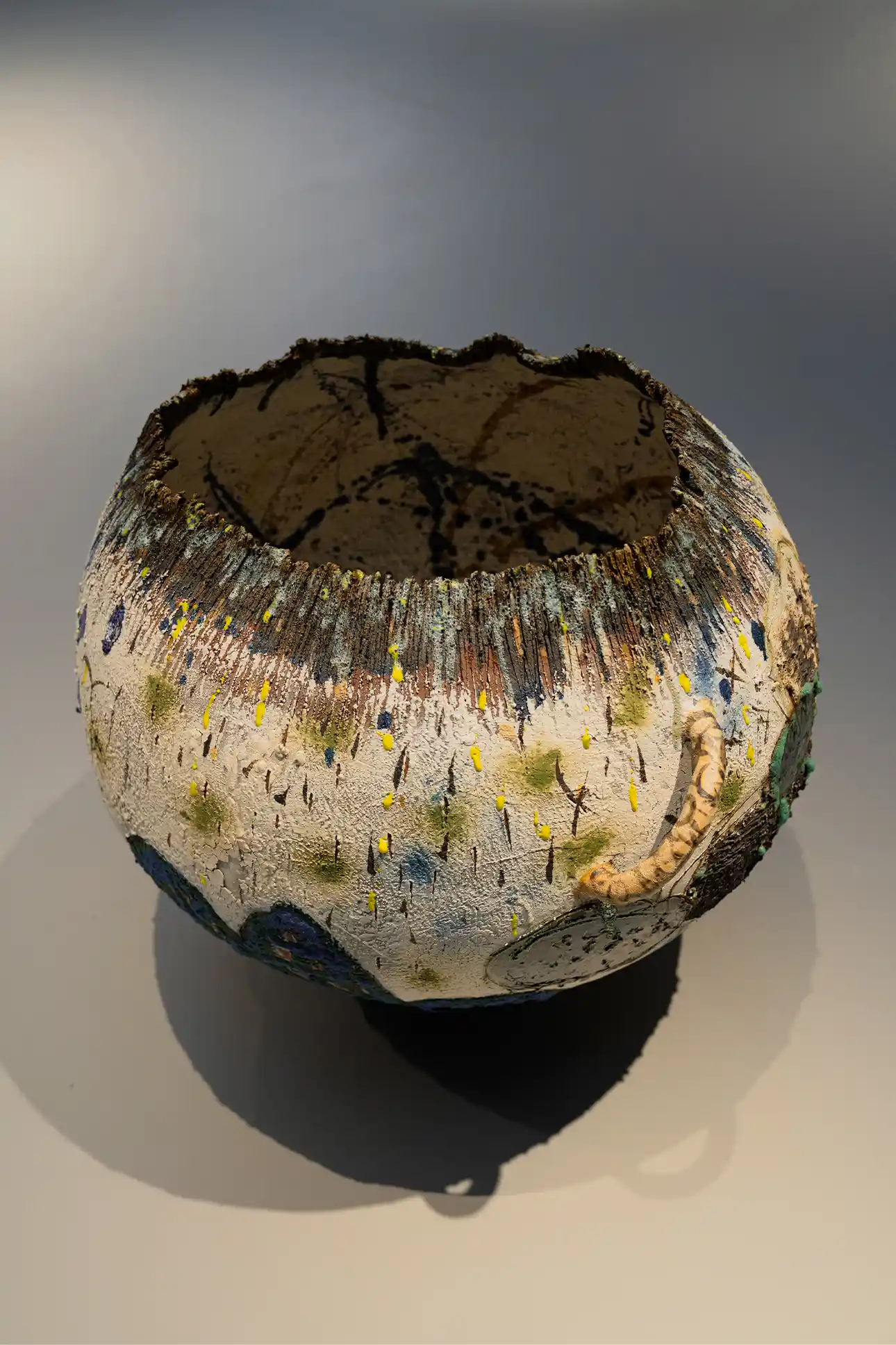
My technique is very traditional, from Korea, but my approach isn’t traditional. For example, I use a method where slip is poured and carved out — I do that, but in my own abstract way. I also use celadon glazes a lot; it’s from a long history. My approach gives just a hint of celadon at certain moments.
I work in two different processes. All the large pieces here are coil-built, from the bottom up. I have an enormous number of coils at my studio, made with different types of clay bodies. You can see many forms here that are very similar to the moon jar, which I find to be one of the most iconic Korean ceramic forms.
I use that form, but for me, it becomes almost like a canvas for painting. I paint on top of the vessel — a lot of mark-making, a lot of layers of glaze. My approach to glaze is slightly different. Some of the glazes I use are very traditional, but the way I apply them — with tiny little brushes, just like a painter — that’s how I paint every single piece.
How do you, as the artist, relate to your own creations?
I always relate myself to ceramics. And I think vessels especially have so much relation with people. In Korea, there’s this saying: if you’re a really generous and kind person, your vessel is very large. But if you’re not generous or kind, your vessel is very small. My parents always told me to be a big vessel, and I think that’s the reason why I make really big, big, big vessels.
At the same time, I’ve felt very vulnerable — as a woman, and as a Korean-American living in America. There are a lot of difficulties and challenges. So when I was making some of the pieces, I wanted something that could really protect me, take care of me. That’s a little bit of my interpretation of that feeling in some of these pieces.
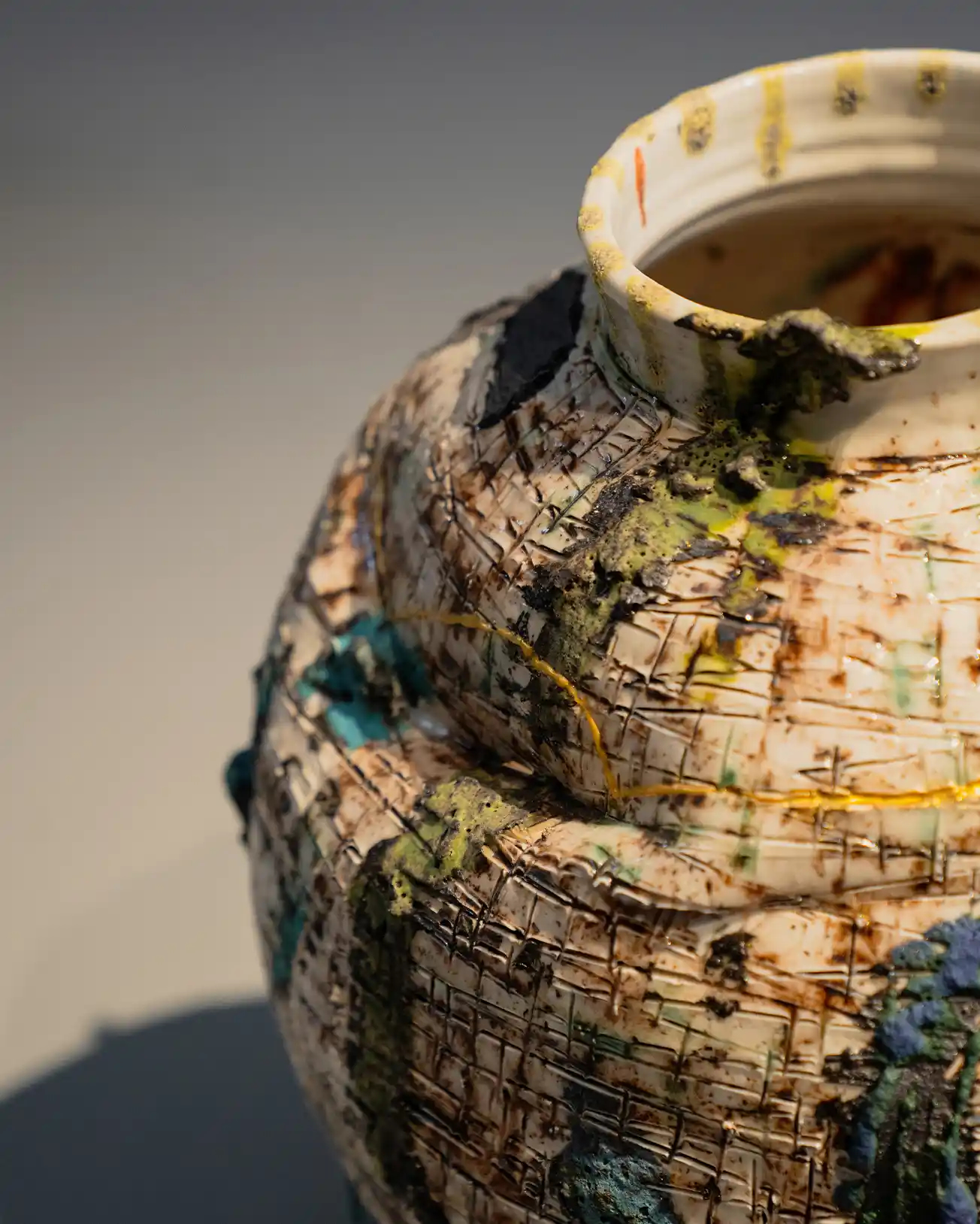
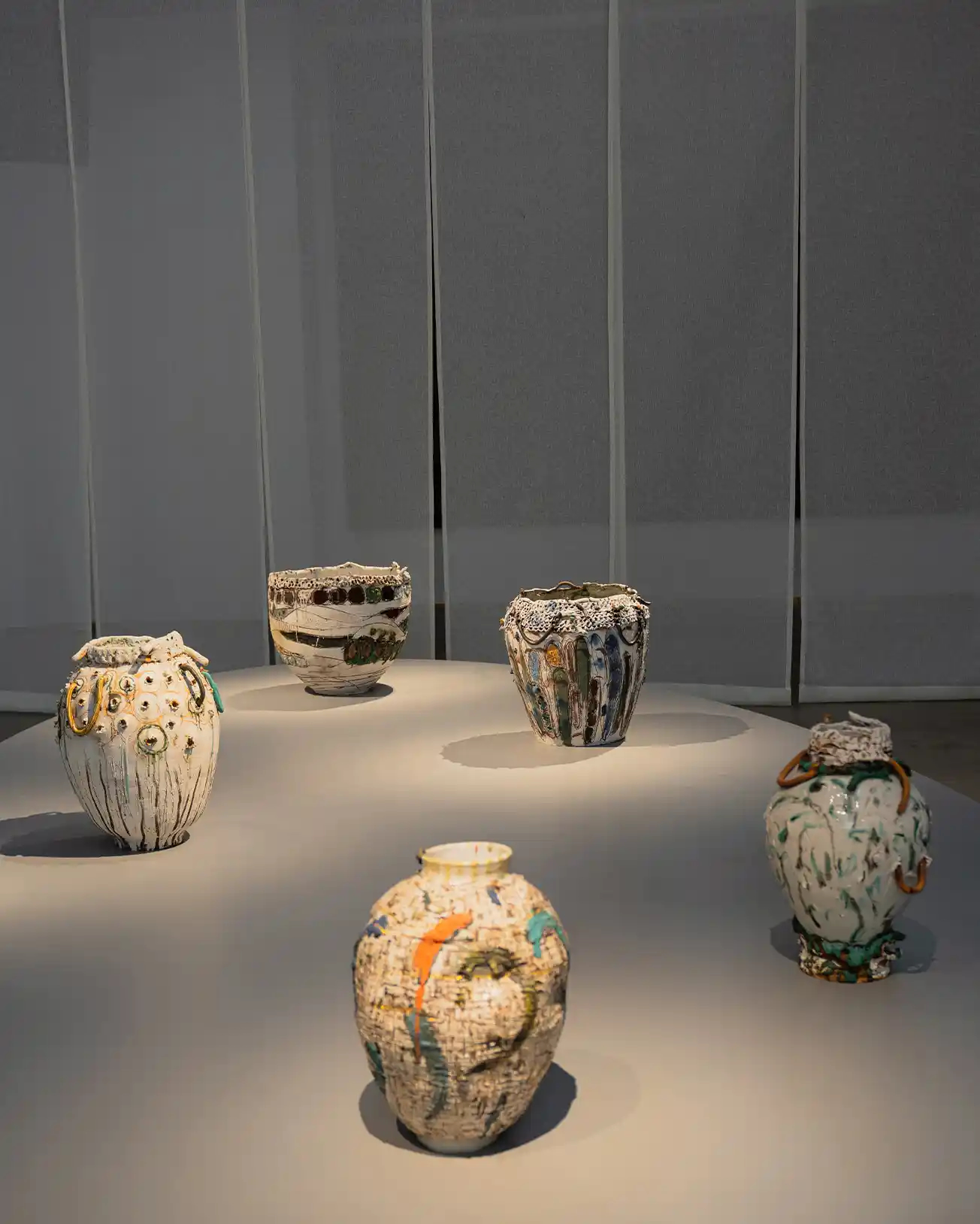
How do you manage to get this kind of texture — the lines and the gaps between them? It almost looks like jute, but it isn’t.
You’ll be surprised — I sit there with a tiny knife and carve. It actually took me a lot longer to make each piece in this exhibition than usual. The reason was that I really wanted to build more memories and history within each piece. If you look at any of them, I literally sat there for hours with a tiny knife, slicing it one by one. It’s almost like meditation for me, a meditative process. I enjoyed it so much, and I wanted people to really see that — the entire history and the building of the texture.
Going back to your inspiration — is there something in your life that you are thinking of in this specific form?
I usually think a lot about what’s happening in my life. I struggle a lot with health, so I have a lot of scars, and emotional difficulties too, because I’ve been through so many surgeries.
All of that comes through in my work. The pieces — you can see — they’re broken and torn apart. But at the end of the day, it’s the glaze that protects them and still makes them beautiful. Just because something is cut and broken doesn’t mean it’s ugly. The vulnerability can be really beautiful — that’s what I wanted to capture in my work. That’s why there are so many cuts and scars.
At the end of the day, when it’s all done, people see it and say, “Wow, it’s beautiful.” For me, those are very painful things — certain memories, certain cuts, certain experiences — but when people see it as a beautiful piece, that makes me very happy.
At the link below read about five Indian artists who speak about creating in clay and its influence on developing an individualistic worldview and style sensibility.
Handmade Stories: This Contemporary Crop of Ceramicists Is Reinvigorating the Age-Old Craft